Your SCA tool catches CVEs.
Who catches everything else?

Account takeovers, typosquats, abandoned packages, license landmines—the risks that ship between scans and don’t have advisory IDs.

Get a Risk Assessment

These weren’t CVEs when they shipped.

Real attacks your current tooling would have missed.

These are 3 of 77 case studies in our database.

What your current tools miss.

SCA tools focus on known vulnerabilities. Supply chain risk is broader than that.

Risk Category Typical SCA Risk Guard
Vulnerability detection Known CVEs only Multi-source: OSV + GHSA + NVD + KEV
Malware & tampering Limited or none Active malware, install scripts, hash verification
Maintainer health Not tracked Bus factor, abandonment signals, contributor trends
License compliance Basic detection Copyleft propagation, commercial restrictions, modified text
Supply chain integrity Not covered Source-registry divergence, typosquatting, dependency confusion
Risk quantification Severity scores Dollar-value exposure per finding

Five pillars. 36 checks. Every vector covered.

Each check maps to a real-world case study.

🛡

Vulnerability & Dependency

Multi-source CVE aggregation, remediation velocity tracking, unfixed vulnerability detection.

🐛

Artifact Integrity & Malware

Active malware detection, install script analysis, hash verification, source-registry divergence.

👤

Maintainer Health & Continuity

Bus factor scoring, abandonment signals at 1yr and 5yr, contributor trend analysis.

§

License Compliance

Copyleft propagation, commercial restrictions, modified license text, missing license detection.

📦

Package Identity & Provenance

Typosquatting detection, dependency confusion, registry mismatch, name impersonation.

77 case studies. Tested against every major tool.

Here’s who would have caught them.

Caught Partial Detected after damage Missed
OSS Risk Guard
95%
Socket
64%
Phylum/Veracode
56%
Sonatype (Nexus)
52%
Mend
32%
Stacklok
16%
Black Duck
16%
Endor Labs
16%
Snyk
15%
Lineaje
10%
OpenSSF Scorecard
2%

Every bar is backed by a documented case study. See full catalog →

Deploy in minutes, not months.

No agents. No build changes. Connect and scan.

Step 1

Connect

Install the GitHub App. Two minutes. Read-only access to your repositories.

Step 2

Scan

Automatic scans on every PR and nightly. 36 checks across all five risk pillars.

Step 3

Act

Findings in PR comments, Slack, or API. Policy enforcement with org-wide defaults and per-repo overrides.

Air-gapped deployment available for regulated environments.

Your policy. Every PR. Automatically.

You define what blocks and what warns. Developers see findings before merge, not after an audit.
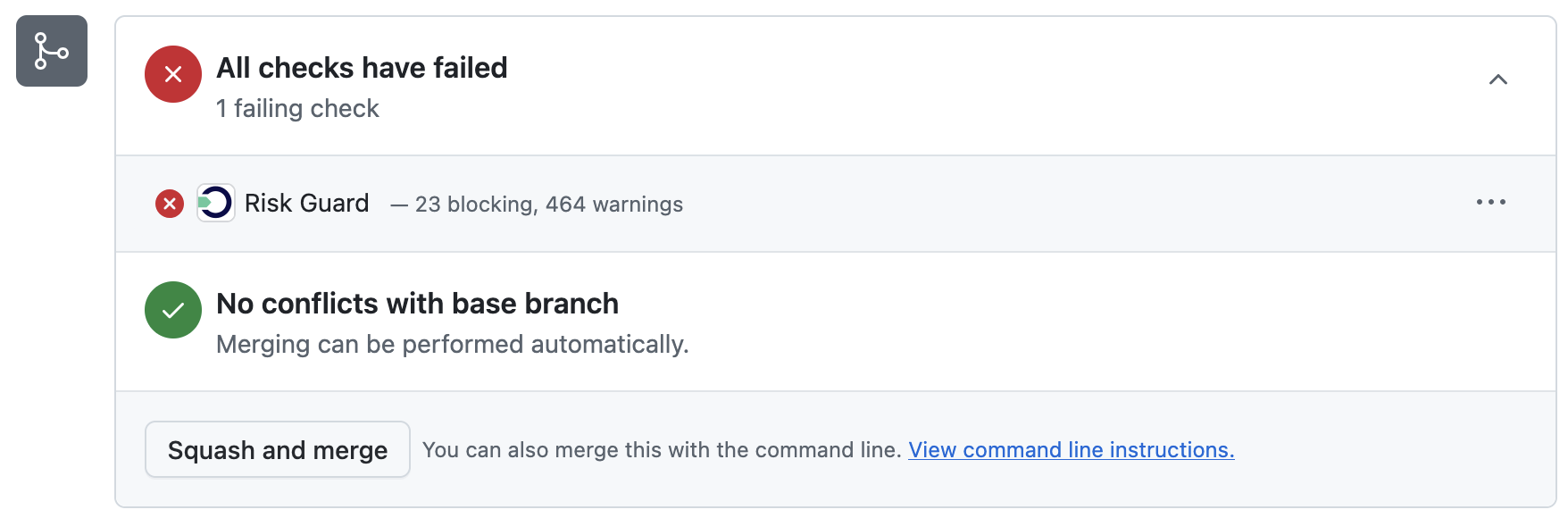
GitHub PR check showing Risk Guard — 23 blocking, 464 warnings

Blocking vs. warnings

Critical risks block the merge. Everything else is visible but doesn’t slow the team down.

Org-wide defaults

Set policy once. Apply everywhere. Override per-repo when needed.

Gradual rollout

Start with warnings only. Promote to blocking on your timeline with time-delayed enforcement.

Insured findings.

Backed by an E&O policy from Brown & Brown. If we miss a material risk, you have financial recourse through our carrier.

The only supply chain vendor with insured findings.

See what your current tools are missing.

Connect a repo. Get findings in minutes. No sales call required.

Get a Risk Assessment